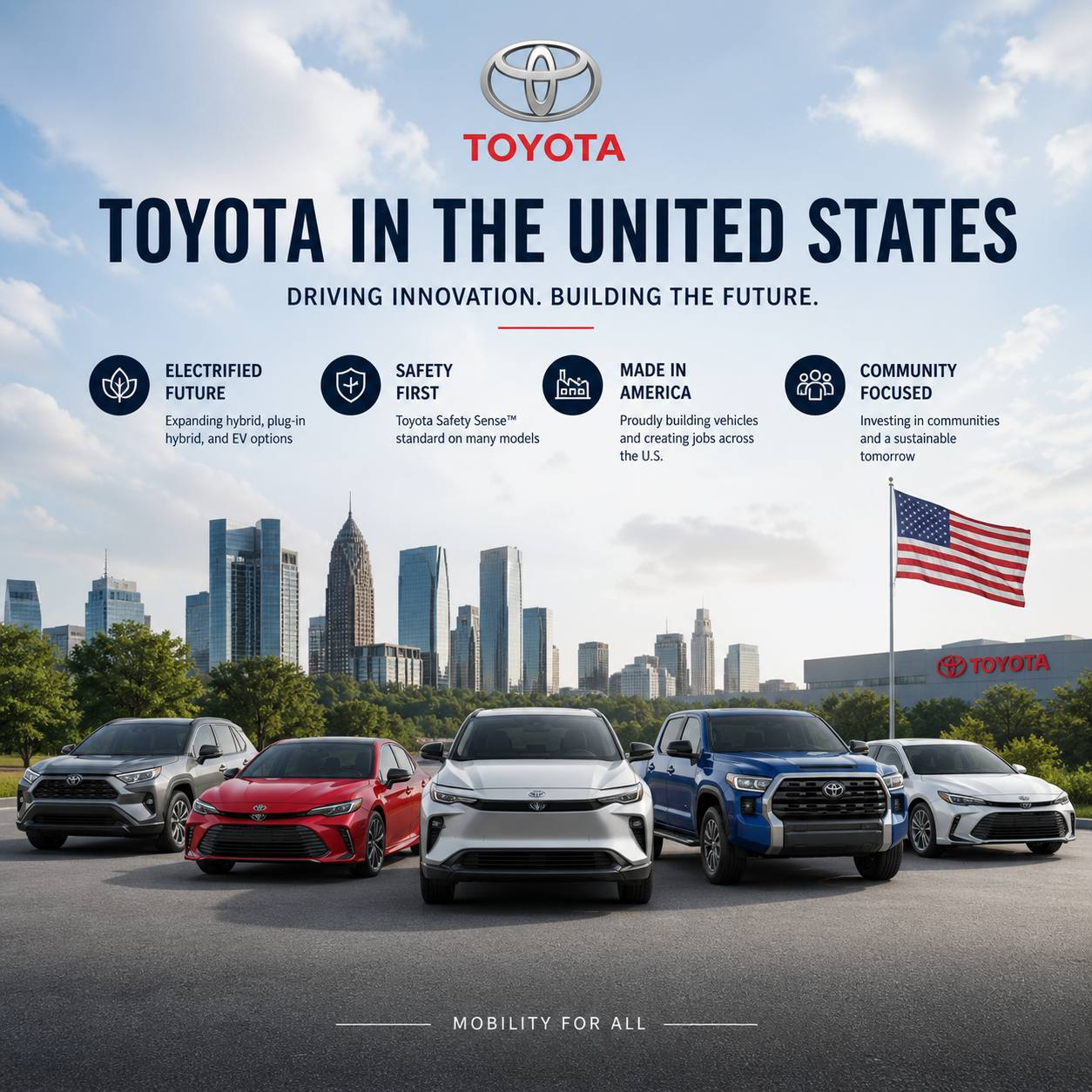
Toyota’s Strategic Evolution in the United States: Innovation, Electrification, and Market Leadership
Toyota has long held a dominant and respected position within the United States automotive market, built on a reputation for reliability, efficiency, and long-term value. However, the company’s current trajectory in the U.S. reflects far more than consistency—it signals a strategic transformation shaped by electrification, technological innovation, and shifting consumer expectations. As the automotive landscape rapidly evolves, Toyota’s approach offers a compelling case study in balancing legacy strengths with forward-looking adaptation.
One of the most prominent themes in Toyota’s recent U.S. strategy is its multifaceted approach to electrification. Unlike some competitors that have moved aggressively toward fully electric vehicles (EVs), Toyota has adopted a diversified pathway, investing simultaneously in hybrid electric vehicles (HEVs), plug-in hybrids (PHEVs), battery electric vehicles (BEVs), and hydrogen fuel cell technology. This “multi-pathway” strategy reflects Toyota’s belief that the U.S. market—due to its size, infrastructure variability, and consumer diversity—requires flexibility rather than a one-size-fits-all solution.
Hybrid technology remains Toyota’s strongest foothold. Models such as the Prius, Camry Hybrid, and RAV4 Hybrid continue to dominate their segments, offering consumers improved fuel efficiency without the infrastructure concerns associated with full EVs. Notably, Toyota has expanded hybrid options across its lineup, making electrification more accessible to mainstream buyers rather than limiting it to niche segments. This incremental transition aligns with current U.S. consumer behavior, where many drivers remain hesitant to fully commit to battery electric vehicles due to charging infrastructure limitations and range anxiety.
At the same time, Toyota is scaling up its BEV presence in the United States. The introduction of models like the bZ4X marks the beginning of a broader electric lineup under the “bZ” (Beyond Zero) branding. While Toyota entered the fully electric market later than some competitors, it is leveraging its manufacturing expertise and supply chain efficiency to ramp up production strategically. The company is also investing heavily in battery production within the United States, including large-scale battery plants aimed at reducing dependency on overseas supply chains and qualifying for federal incentives under evolving U.S. regulations.
Beyond electrification, Toyota is making significant advancements in vehicle technology and user experience. Modern Toyota vehicles in the U.S. are increasingly equipped with advanced driver-assistance systems (ADAS), integrated infotainment platforms, and over-the-air (OTA) software update capabilities. Toyota Safety Sense, the company’s suite of safety features, has become standard across many models, reinforcing its commitment to safety as a core brand value. Meanwhile, improvements in connectivity—such as smartphone integration, cloud-based navigation, and personalized driver settings—are helping Toyota compete in a market where digital experience is becoming as important as mechanical performance.
Another critical area of focus is manufacturing localization and supply chain resilience. In response to global disruptions and shifting trade dynamics, Toyota has intensified its investment in U.S.-based production facilities. The company operates numerous plants across states such as Kentucky, Texas, and Indiana, producing both vehicles and components. These investments not only support job creation but also enhance Toyota’s ability to respond quickly to domestic demand fluctuations. Localization also plays a key role in meeting regulatory requirements and qualifying for incentives tied to domestic manufacturing.
Toyota’s truck and SUV segments remain central to its success in the U.S., where consumer preference continues to lean heavily toward larger vehicles.
The Toyota Tacoma, Tundra, and 4Runner have maintained strong market positions, supported by recent redesigns that emphasize performance, durability, and modern features. The latest generation of the Tundra, for example, incorporates hybrid technology in a full-size pickup—a move that signals Toyota’s intent to bring electrification even into traditionally fuel-intensive segments. This strategy not only broadens Toyota’s appeal but also positions it competitively against domestic brands that dominate the truck market.
Sustainability, beyond electrification, is also shaping Toyota’s narrative in the United States. The company has set ambitious environmental goals, including carbon neutrality across its operations and vehicle lifecycle. This includes reducing emissions in manufacturing processes, improving fuel efficiency across all models, and exploring alternative energy sources such as hydrogen. Toyota’s hydrogen fuel cell vehicle, the Mirai, while still niche, represents a long-term investment in zero-emission technology that could complement battery electric solutions in the future.
Consumer perception and brand loyalty continue to be key strengths for Toyota in the U.S. market. Decades of consistent performance have built trust among American drivers, particularly in terms of reliability and resale value. However, Toyota is also working to reshape its image to appeal to younger and more tech-savvy consumers. This includes sportier vehicle designs, enhanced driving dynamics, and marketing campaigns that emphasize innovation and sustainability. The introduction of performance-oriented models under the GR (Gazoo Racing) brand, such as the GR Corolla and GR86, reflects an effort to engage enthusiasts while maintaining mainstream appeal.
Looking ahead, Toyota’s success in the United States will depend on its ability to execute its multi-pathway strategy effectively while remaining responsive to regulatory changes and market trends. Government policies promoting EV adoption, advancements in battery technology, and increasing competition from both traditional automakers and new entrants will all influence the competitive landscape. Toyota’s measured approach—combining steady innovation with calculated risk—may prove advantageous in navigating these uncertainties.
In conclusion, Toyota’s current trajectory in the United States highlights a company in transition, balancing its legacy of reliability with the demands of a rapidly changing automotive industry. Through a diversified electrification strategy, technological advancement, localized manufacturing, and sustained focus on consumer needs, Toyota is positioning itself not just to remain relevant, but to lead in the next era of mobility. For industry observers and consumers alike, Toyota’s evolution offers valuable insight into how established automakers can adapt without losing the core principles that defined their success.