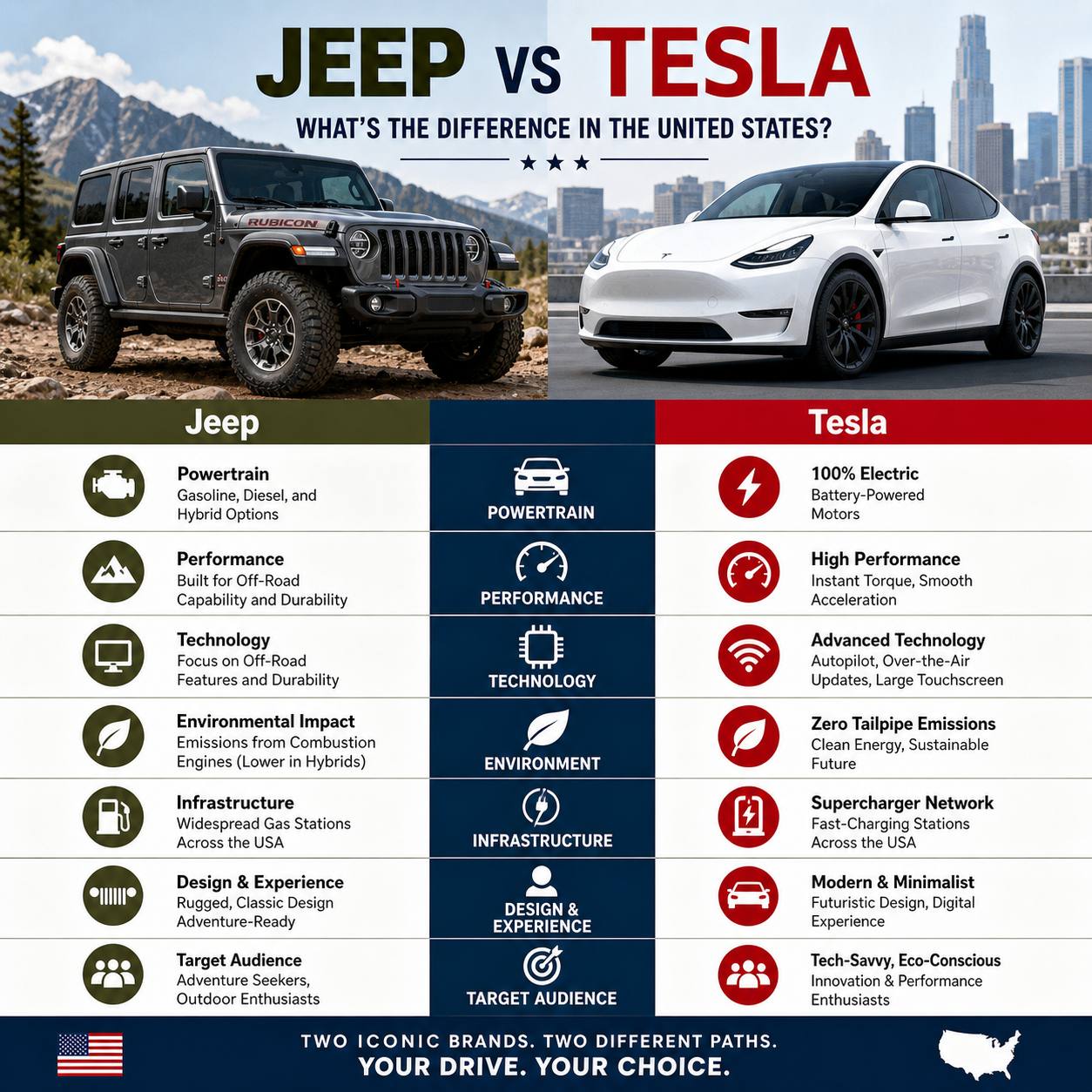
The American automotive landscape is undergoing a transformative shift, driven by technological innovation, environmental concerns, and evolving consumer preferences. Two brands that symbolize contrasting approaches to mobility are Jeep and Tesla. Jeep, a legacy automaker rooted in rugged utility and off-road heritage, represents tradition and durability. Tesla, on the other hand, is a disruptive force that has redefined the industry through electric vehicles (EVs), cutting-edge software, and a vision for sustainable transportation. Understanding the differences between Jeep and Tesla requires examining their design philosophies, performance capabilities, technological advancements, environmental impact, and target audiences.
1. Brand Identity and Philosophy
Jeep has long been associated with adventure, freedom, and off-road capability. Established during World War II, Jeep vehicles were originally designed for military use, which laid the foundation for their reputation as durable and versatile machines. Today, Jeep continues to emphasize ruggedness, with models like the Wrangler and Gladiator built for extreme terrains.
Tesla, founded in 2003 by engineers aiming to accelerate the world’s transition to sustainable energy, represents innovation and future-forward thinking. Tesla’s brand identity is closely tied to clean energy, autonomous driving technology, and a minimalist, high-tech user experience. Unlike Jeep, Tesla does not rely on decades of automotive tradition but instead focuses on redefining what a car can be.
2. Powertrain and Performance
One of the most fundamental differences between Jeep and Tesla lies in their powertrains. Traditional Jeep vehicles primarily use internal combustion engines (ICE), powered by gasoline or diesel. These engines are designed for torque and durability, essential for off-road driving. However, Jeep has begun transitioning toward electrification with hybrid and fully electric models, such as the Jeep Wrangler 4xe and the all-electric Jeep Recon.
Tesla vehicles are fully electric, utilizing battery-powered motors instead of combustion engines. This results in several advantages, including instant torque, smooth acceleration, and reduced mechanical complexity. Tesla models like the Model S and Model 3 are known for their rapid acceleration, often outperforming traditional sports cars in 0–60 mph times.
While Jeep excels in off-road performance with features like four-wheel drive systems, locking differentials, and high ground clearance, Tesla dominates in on-road performance, offering quiet rides and superior handling due to a low center of gravity from battery placement.
3. Technology and Innovation
Tesla is widely recognized as a leader in automotive technology. Its vehicles are equipped with advanced software systems, including over-the-air (OTA) updates that continuously improve performance, add features, and fix issues without requiring dealership visits. Tesla’s Autopilot and Full Self-Driving (FSD) capabilities represent a significant step toward autonomous driving, although they remain under regulatory scrutiny.
Jeep, while incorporating modern technology, tends to prioritize mechanical reliability over digital innovation. Features such as off-road navigation systems, terrain management modes, and trail-rated capabilities are central to Jeep’s technological approach. Jeep vehicles also include infotainment systems and driver-assistance features, but they are generally less advanced compared to Tesla’s software ecosystem.
4. Environmental Impact
Environmental considerations are a major differentiator between the two brands. Tesla’s fully electric vehicles produce zero tailpipe emissions, making them an attractive option for environmentally conscious consumers. Additionally, Tesla invests in renewable energy solutions, including solar panels and battery storage systems, reinforcing its commitment to sustainability.
Jeep’s traditional gasoline-powered vehicles contribute to carbon emissions, although the company is actively working to reduce its environmental footprint. The introduction of plug-in hybrid models and upcoming electric vehicles reflects Jeep’s effort to align with stricter emissions regulations and changing consumer expectations in the United States.
However, it is worth noting that the environmental impact of EVs depends on factors such as electricity sources and battery production. While Tesla vehicles are cleaner in operation, the broader lifecycle impact remains a topic of ongoing discussion.
5. Design and User Experience
Jeep vehicles are designed with practicality and ruggedness in mind. Their boxy shapes, removable doors and roofs (in models like the Wrangler), and durable interiors cater to outdoor enthusiasts. The driving experience is often more tactile and mechanical, appealing to those who enjoy a hands-on connection with their vehicle.
Tesla’s design philosophy emphasizes minimalism and modernity. Interiors are sleek, often dominated by a large central touchscreen that controls most vehicle functions. Physical buttons are minimized, creating a clean and futuristic aesthetic. Tesla vehicles are designed for comfort, efficiency, and ease of use, particularly in urban and suburban environments.
6. Infrastructure and Convenience
Tesla has a significant advantage in charging infrastructure through its extensive Supercharger network across the United States. This network enables relatively fast and convenient long-distance travel for EV owners. Tesla also integrates navigation with charging station locations, simplifying trip planning.
Jeep vehicles, relying primarily on gasoline, benefit from the widespread availability of fuel stations. This makes refueling quick and convenient, particularly in remote areas where EV charging infrastructure may be limited. However, as Jeep introduces more electric models, it will need to rely on expanding public charging networks to remain competitive.
7. Target Market and Consumer Appeal
Jeep appeals to consumers who value adventure, off-road capability, and a sense of tradition. Its vehicles are popular among outdoor enthusiasts, rural drivers, and those seeking a rugged lifestyle image. Jeep ownership often carries an emotional connection tied to exploration and resilience.
Tesla targets a different demographic—tech-savvy, environmentally conscious consumers who prioritize innovation and performance. Tesla owners are often early adopters of new technology and are drawn to the brand’s forward-thinking approach.
Conclusion
The comparison between Jeep and Tesla highlights a broader shift in the automotive industry. Jeep represents the enduring appeal of traditional engineering, off-road capability, and lifestyle-driven design. Tesla embodies the future of transportation, characterized by electrification, software integration, and sustainability.
As the United States moves toward stricter environmental regulations and increased adoption of electric vehicles, the gap between these two brands may narrow. Jeep’s ongoing electrification efforts suggest that even legacy automakers are adapting to the changing landscape. Meanwhile, Tesla continues to push the boundaries of innovation, setting new standards for the industry.
Ultimately, the choice between Jeep and Tesla depends on individual priorities. Those seeking rugged performance and outdoor adventure may gravitate toward Jeep, while those focused on technology, efficiency, and sustainability are more likely to choose Tesla. Both brands, in their own ways, contribute to the evolving story of mobility in America.