Land Rover Car Engines: 5 Key Features That Define Innovation and Efficiency
Land Rover, renowned for its legendary off-road capability and luxury SUVs like the Range Rover, Defender, Discovery, and Evoque, has evolved its powertrains significantly. At the heart of modern Land Rovers lies the Ingenium engine family — Jaguar Land Rover’s (JLR) in-house developed modular engines. These all-aluminium, turbocharged units in petrol, diesel, and mild-hybrid (MHEV) configurations prioritize performance, refinement, low emissions, and fuel efficiency while maintaining the torque and durability essential for challenging terrains.
This approximately 1000-word article explores five key features that define the innovation and efficiency of Land Rover car engines, drawing primarily from the Ingenium lineup used across current models.
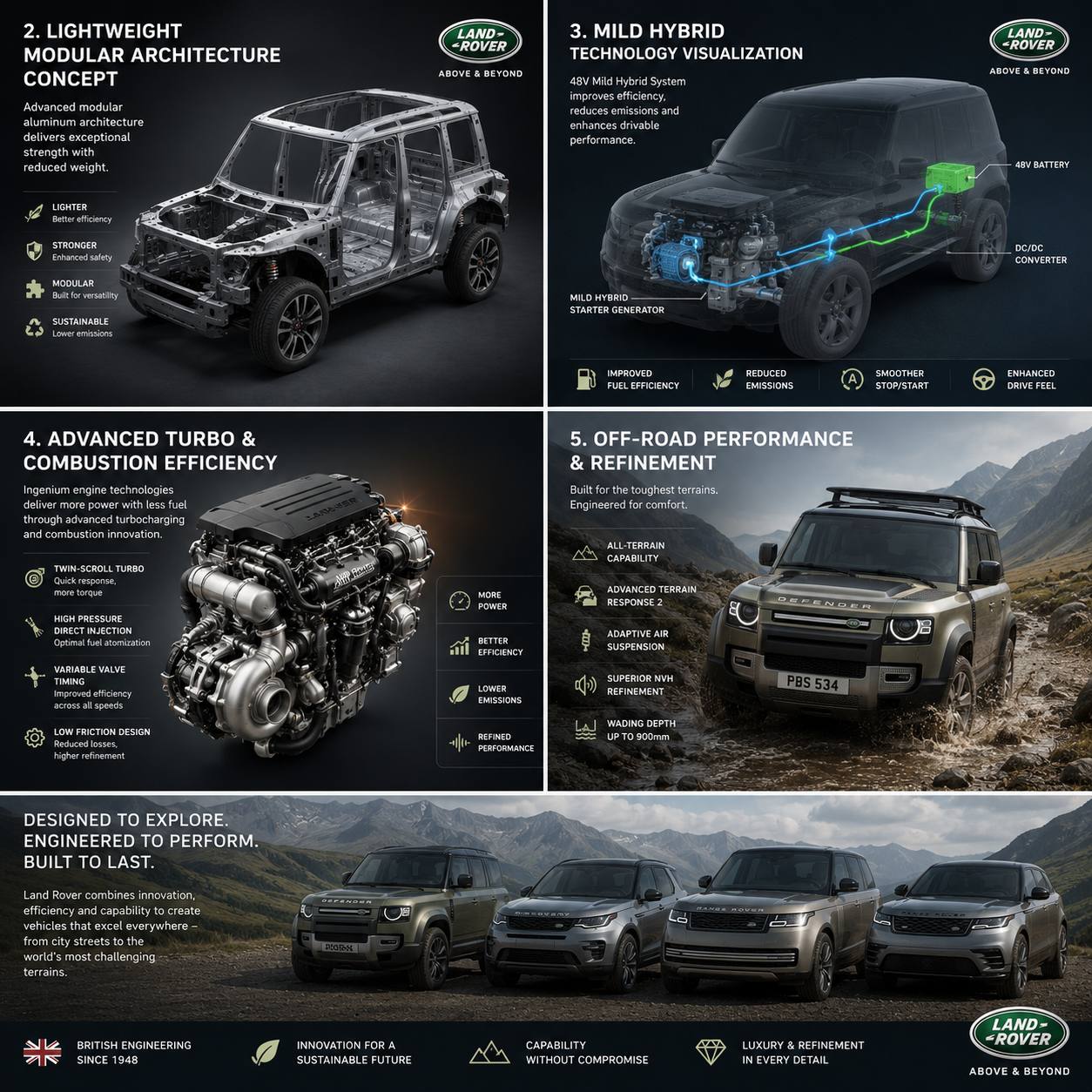
1. Modular All-Aluminium Architecture and Lightweight Design
One cornerstone of Land Rover’s engine innovation is the lightweight, modular all-aluminium construction of the Ingenium family. Built around individual 500cc cylinders, the design supports 3-, 4-, and 6-cylinder variants, allowing flexibility for different vehicle architectures (longitudinal or transverse, AWD configurations) and power outputs.
This architecture results in engines up to 80 kg lighter than predecessors. Reduced weight directly improves fuel efficiency, lowers emissions, and enhances vehicle dynamics — crucial for an SUV that must balance on-road refinement with off-road prowess. The aluminium block and head, combined with optimized internal components, minimize thermal mass for faster warm-up, reducing fuel use and wear during cold starts.
In practice, this translates to better power-to-weight ratios. For instance, the 2.0L Ingenium turbo engines in models like the Discovery Sport or Defender deliver responsive performance without excess mass penalizing efficiency. The modularity future-proofs the lineup, easing integration of hybrid systems and supporting JLR’s transition toward electrification. This design choice embodies efficient engineering: less material waste in manufacturing, lower vehicle mass on the road, and scalable performance.
2. Advanced Low-Friction Technologies and Variable Systems
Ingenium engines incorporate multiple innovations to slash internal friction — reported as up to 17% lower than prior diesels. Key elements include roller bearings on camshafts and balancer shafts (instead of plain machined surfaces), a simplified cam drive, offset crankshafts, and electronically controlled piston cooling jets.
Computer-controlled variable oil and water pumps adjust flow based on real-time engine speed, load, and temperature, saving parasitic energy losses. A split-circuit cooling system enables rapid warm-up, while variable valve timing and efficient turbochargers optimize airflow and combustion across the rev range.
These features yield tangible benefits: smoother, quieter operation; improved low-end torque for effortless overtaking and towing; and superior fuel economy. Drivers experience refined power delivery whether cruising highways or tackling mud, sand, or rock. Reduced friction also extends service intervals — some Ingenium units allow up to 21,000 miles between services due to lower oil consumption and cleaner combustion.
This focus on minimizing energy losses exemplifies how Land Rover marries mechanical innovation with efficiency, setting Ingenium apart from many outsourced engines of the past.
3. Mild Hybrid Electric Vehicle (MHEV) Integration
Electrification via 48-volt mild-hybrid systems represents a pivotal step in Land Rover’s efficiency strategy. Many current Ingenium engines — particularly inline-6 petrol and diesel variants in the Range Rover, Defender, and Discovery — pair with an integrated starter-generator (ISG) that provides torque assist, enables smoother stop-start, and recaptures energy through regenerative braking.
MHEV technology delivers several advantages: instant electric torque fill for sharper throttle response, reduced engine load during cruising (improving MPG), and lower overall emissions. The system supports features like extended engine-off coasting and enhanced energy management tailored to Land Rover’s Terrain Response systems.
Real-world gains include better combined fuel economy figures and compliance with stringent emissions standards (EU6 and beyond), all while preserving the full off-road capability that defines the brand. For example, 3.0L Ingenium six-cylinder MHEV units offer impressive horsepower (e.g., around 355-395 hp in P360/P400 tunes) with strong torque (often exceeding 350 lb-ft) and refined operation.
This hybrid approach bridges traditional combustion with the future, allowing Land Rover to deliver luxury performance SUVs that are cleaner and more economical without sacrificing the brand’s adventurous spirit.
4. Optimized Turbocharging, Direct Injection, and Combustion Efficiency
Land Rover engines leverage sophisticated forced induction and fuel delivery for a broad, usable powerband. Efficient turbochargers (often twin-scroll or variable geometry) paired with central high-pressure direct fuel injection ensure precise combustion, minimizing unburnt fuel and emissions while maximizing torque from low RPMs — vital for off-roading and towing.
Variable valve timing further refines this, adjusting for optimal efficiency or performance as needed. The result is class-competitive power with strong efficiency: diesel Ingenium units historically achieved excellent MPG (some 2.0L variants approaching impressive combined figures), while petrol counterparts balance thrill with reasonable consumption, especially in MHEV form.
These technologies also contribute to lower NOx and CO2 outputs, supporting Land Rover’s environmental goals. In six-cylinder configurations, the inline layout provides inherent smoothness, enhanced by active noise cancellation in some models, delivering a quiet, premium cabin experience.
Innovation here lies in holistic optimization — not just raw power, but usable, efficient power across diverse driving conditions, from urban commutes to expeditions.
5. Scalability, Refinement, and Future-Proof Sustainability Focus
The Ingenium family’s scalability and emphasis on refinement tie everything together. Common core technologies across variants reduce development costs and improve reliability, while in-house UK manufacturing (Wolverhampton Engine Manufacturing Centre) ensures quality control. Over 1.5 million units produced highlight its success.
Refinement features — lighter reciprocating masses, balanced designs, and electronic aids — create smooth, quiet power delivery that belies the engines’ capability. This suits Land Rover’s dual personality: serene luxury on pavement and unstoppable off-road.
Looking ahead, these engines support JLR’s “Destination Zero” mission with reduced environmental impact, paving the way for greater hybridization and full electrification. Ingenium’s flexibility eases integration of plug-in hybrids (PHEV) and positions the brand for evolving regulations and customer demands for sustainable luxury.
Conclusion
Land Rover’s engines, epitomized by the Ingenium family, showcase a thoughtful blend of innovation and efficiency. Through lightweight modular design, low-friction engineering, mild-hybrid assistance, advanced combustion tech, and scalable refinement, they deliver the power, torque, and durability expected of iconic off-roaders while addressing modern demands for lower emissions and running costs.
Whether in a nimble Evoque or a commanding Range Rover, these engines enhance capability without compromise. As the automotive world shifts toward electrification, Land Rover’s current powertrains stand as a testament to intelligent engineering — proving that innovation can make legendary vehicles both more efficient and more enjoyable to drive.
With ongoing advancements, the future promises even cleaner, smarter propulsion while retaining the soul of adventure that defines the brand.
(Word count: approximately 1020)
This article highlights how targeted engineering delivers real-world benefits for drivers seeking both performance and responsibility. For the latest model-specific specs, consult official Land Rover sources, as powertrain options continue to evolve.