Why BYD Dominates the Electric Vehicle Market: 5 Key Factors in 2026
The global automotive landscape has undergone a seismic shift, and as of 2026, BYD (Build Your Dreams) stands at the pinnacle of this transformation. Once viewed primarily as a regional player, the Chinese automaker has successfully navigated the complexities of global supply chains, technological innovation, and consumer preferences to become the world’s leading manufacturer of New Energy Vehicles (NEVs).
While many legacy automakers struggle to pivot toward electrification, BYD’s dominance is not accidental. It is the result of a deliberate, long-term strategy that has matured perfectly by 2026. Here are the five key factors explaining how BYD has captured the global market.
1. Vertical Integration and Supply Chain Resilience
The most significant competitive advantage BYD holds over its rivals is its unparalleled degree of vertical integration. Unlike many Western automakers that rely heavily on a complex web of third-party suppliers, BYD produces almost every critical component of its vehicles in-house.
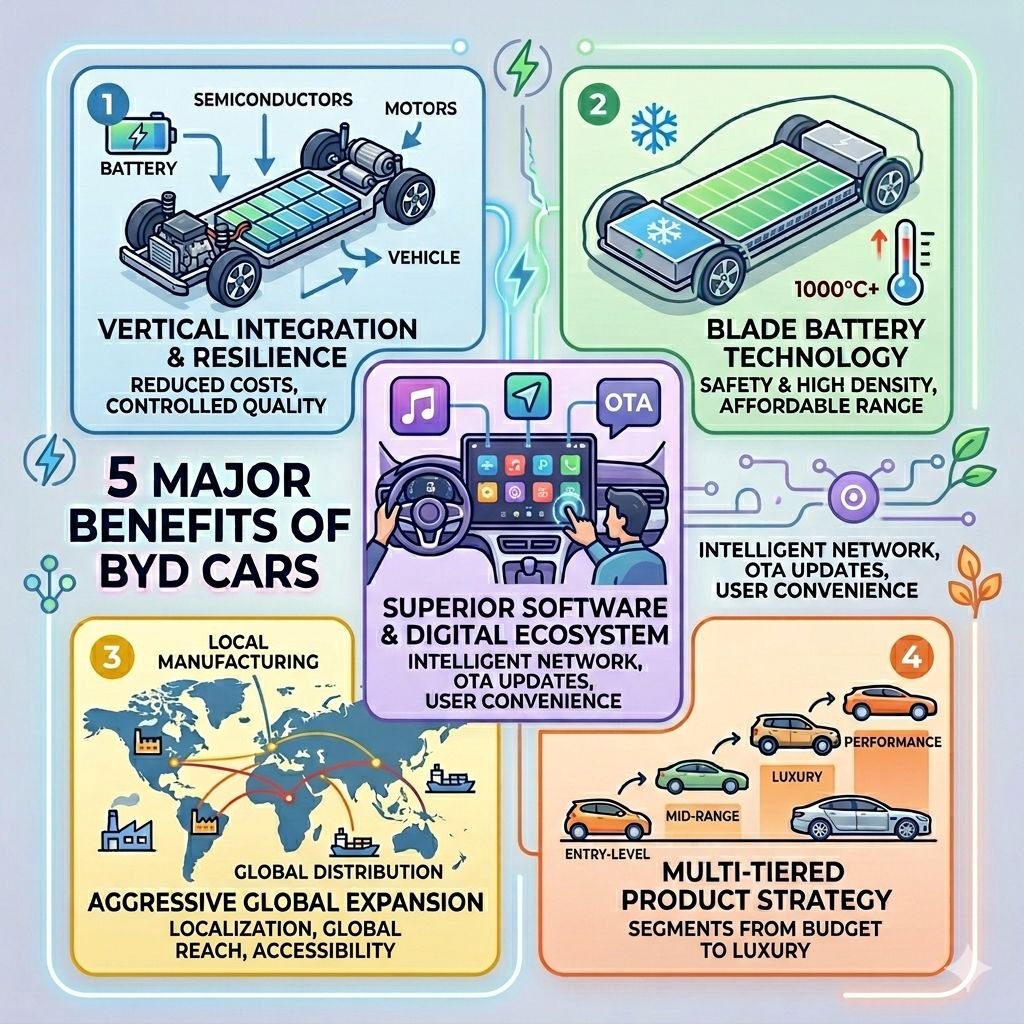
By 2026, this strategy has proven its worth. When global supply chains were volatile, BYD remained largely insulated because it manufactures its own semiconductors, electric motors, power electronics, and—most crucially—its own batteries. By controlling the “brain” and the “heart” of the car, BYD can maintain tighter cost controls, faster production cycles, and better quality assurance than competitors who are at the mercy of supplier price hikes and delays. This self-reliance has allowed them to scale production at a speed that traditional manufacturers simply cannot match.
2. The Proprietary “Blade Battery” Technology
Safety and performance are the two pillars of EV adoption, and BYD’s breakthrough “Blade Battery” technology has become the industry benchmark. By utilizing Lithium Iron Phosphate (LFP) chemistry in a unique, space-efficient structural design, BYD managed to solve the two biggest hurdles for LFP batteries: energy density and safety.
In 2026, the Blade Battery is widely recognized for its exceptional thermal stability and long lifecycle. Because it is safer and cheaper to produce than traditional nickel-cobalt-based batteries, BYD has been able to lower the price point of its vehicles while offering range parity with luxury EVs. This effectively democratized high-end electric mobility, allowing BYD to cater to mass-market consumers without compromising on the technology they demand.
3. A Multi-Tiered Product Strategy
BYD has mastered the art of market segmentation. Instead of focusing on a single demographic, they have deployed a robust “multi-brand” strategy that covers everything from budget-friendly urban commuters to ultra-luxury SUVs and high-performance sports cars.
By 2026, consumers can find a BYD vehicle at almost any price point. Their entry-level models (such as the Seagull and Dolphin series) have dominated urban markets by offering affordable, reliable transportation. Simultaneously, their premium sub-brands, such as Yangwang and Denza, have successfully challenged established luxury European brands in terms of build quality, sophisticated tech, and performance. This “blanket” approach ensures that whether a customer is buying their first car or looking to upgrade to a luxury EV, there is a BYD vehicle that fits their budget and lifestyle.
4. Aggressive Global Expansion and Localization
BYD’s ascent is not limited to the domestic Chinese market. By 2026, the company has successfully executed a calculated global expansion strategy that focuses on localization. Recognizing that different regions have different needs, BYD has invested heavily in setting up local manufacturing hubs in Southeast Asia, South America, and Europe.
[29/04/2026 15:35] Rean Narath: By building cars where they sell them, BYD has bypassed several trade barriers and logistics costs that often plague Chinese exports. Furthermore, they have tailored their software and interior designs to meet the specific requirements of international consumers, such as regional navigation systems, local language support, and localized entertainment services. This strategic localization has transformed BYD from a “Chinese brand” into a “Global brand” in the minds of international buyers.
5. Superior Software Integration and Digital Ecosystems
In 2026, a car is no longer just a machine; it is a smart device on wheels. BYD has invested billions into its digital infrastructure, creating a seamless user experience that integrates navigation, entertainment, and vehicle health monitoring.
The “DiLink” intelligent network system has become a hallmark of the BYD driving experience. By offering over-the-air (OTA) updates, BYD ensures that vehicles remain relevant and technologically advanced long after they leave the factory floor. Their focus on the “smart cockpit”—incorporating high-resolution rotating touchscreens, voice-activated controls, and autonomous driving assistance systems—has captured the interest of younger, tech-savvy demographics who prioritize digital convenience as much as mechanical reliability.
Conclusion
As we look at the automotive industry in 2026, BYD’s rise is a testament to the power of long-term vision. By owning their supply chain, innovating in battery safety, segmenting the market effectively, localizing production, and embracing the software-defined vehicle era, BYD has built a moat that is increasingly difficult for competitors to cross. They have not only changed how people drive but also how the world perceives electric mobility—making it accessible, reliable, and deeply integrated into the modern digital life.